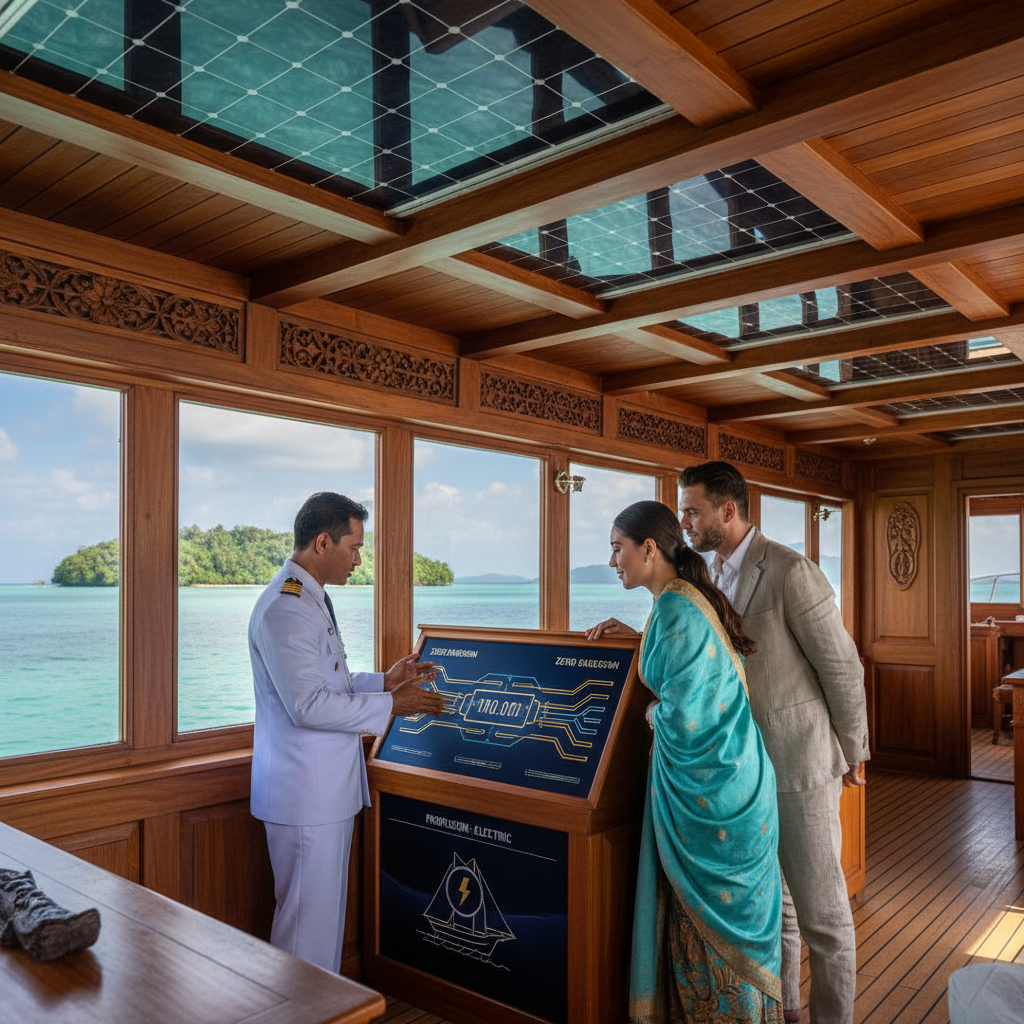
The Silent Revolution: Electric Yacht Technology Explained
The familiar thrum of a diesel engine, often exceeding 85 decibels, has long been the soundtrack to marine exploration. Yet, a silent revolution is underway, replacing the noise and fumes with the whisper of water against the hull. This is the world of the electric yacht, a paradigm shift in sustainable luxury. For those who seek to explore Indonesia’s 17,504 pristine islands without leaving a trace, understanding the technology behind a zero emission phinisi is the first step towards a truly conscious and immersive journey.
Beyond the Roar: The Allure of the Silent Cruising Experience
Imagine gliding into the sheltered bays of the Komodo National Park, the only sounds being the lapping of waves and the call of a sea eagle overhead. This is the profound difference of silent cruising. Traditional yachts announce their arrival with engine noise, a disturbance that can travel up to 20 kilometers underwater, impacting cetacean communication. An electric boat propulsion system, by contrast, operating at a near-silent 35 decibels, allows for an unobtrusive presence, transforming the entire dynamic between vessel and nature.
This is not merely an absence of noise; it is the presence of everything else. You can hear the gentle exhalation of a surfacing manta ray, whose wingspan can reach up to 7 meters, at Manta Point. Or, you can discern the intricate chorus of the rainforest canopy, home to over 300 bird species, as you anchor off a remote cove in Raja Ampat. Onboard, conversations are held at a normal volume, the clink of a glass is not lost to engine vibration, and the sense of peace is absolute. This heightened sensory awareness is one of the most compelling advantages of electric boats.
The Heart of the Machine: Marine Battery and Propulsion Systems
At the core of a zero emission phinisi lies a sophisticated integration of advanced marine battery technology and high-torque electric motors. Unlike their automotive counterparts, marine systems must be engineered for uncompromising reliability. Our vessels utilise state-of-the-art, high-density Lithium Iron Phosphate (LFP) battery banks with capacities exceeding 600 kWh, housed in climate-controlled compartments with an IP67 waterproof rating to ensure rigorous safety against the corrosive saltwater environment.
These banks power whisper-quiet, direct-drive electric motors with over 95% energy efficiency. The immediate and silent delivery of torque provides exceptional manoeuvrability, a significant advantage when navigating the delicate coral gardens of the Coral Triangle, an area containing 76% of the world’s known coral species. The entire electric boat propulsion system is managed by intelligent software that optimises energy consumption, monitors cell health, and ensures a seamless, efficient performance. This is sustainable marine engineering at its most refined.
Harnessing the Sun: Solar Integration on a Modern Phinisi
The traditional, expansive decks of an Indonesian phinisi, often providing over 150 square meters of usable space, offer the perfect canvas for a large, high-efficiency solar array. A solar powered yacht is not a novelty; it is a fundamental component of a truly autonomous marine platform. We integrate marine-grade photovoltaic panels, with a total output of over 20 kWp (kilowatt-peak), discreetly into the vessel’s design, ensuring they complement the classic aesthetic while constantly harvesting the abundant equatorial sun.
From the bright, clear skies over the Flores Sea to the intense sun of the Dampier Strait, which averages over 8 peak sun-hours per day, this solar array continuously replenishes the battery banks. During daylight hours, the system can generate over 100 kWh of energy, more than enough to run all onboard systems—from navigation and air conditioning to the galley and water makers that produce 250 liters of fresh water per hour. This constant, silent energy production significantly extends range and enables indefinite periods of off-grid operation.
Regenerative Sailing: A Self-Sustaining Voyage
One of the most elegant innovations in electric yachting is the concept of regenerative sailing. It is a principle that transforms the vessel into a self-sustaining ecosystem, working in harmony with the forces of wind and water. When the sails are raised and the vessel is propelled by the wind at speeds above 6 knots, the electric motors can be set to reverse. In this mode, the propellers spin freely, acting as hydroelectric turbines that can generate between 1 to 3 kW of power, continuously trickling charge back into the battery banks.
This motion generates significant electrical current, which is fed directly back into the marine battery banks, recharging them as you sail. A brisk sail across the Savu Sea from Sumba to Komodo can replenish a substantial amount of the energy consumed during a period of motor-cruising. This symbiotic relationship between wind and water creates a closed-loop energy system, embodying the essence of low impact sailing and moving a zero emission phinisi closer to perpetual motion at sea.
Sustainable by Design: The Broader Eco-Engineering Philosophy
True sustainability extends far beyond the propulsion system. The philosophy behind a zero emission phinisi permeates every aspect of its construction and operation. Our editorial standards and vetting process for materials and systems are uncompromising. This commitment begins with the build, favouring reclaimed ironwood and sustainably sourced timbers, and eliminating the use of toxic antifouling paints.
Onboard, this ethos continues with state-of-the-art waste treatment systems that render all black and grey water safe for discharge. Single-use plastics are entirely eliminated, replaced with elegant, reusable alternatives. We source provisions from local, organic farms in Bali and Flores, supporting communities and ensuring the freshest produce. This holistic approach to sustainable marine engineering ensures that our footprint on Indonesia’s fragile ecosystems is as light as the wind in our sails.
The Zero Emission Phinisi: Indonesia’s Electric Yacht Pioneer
The Zero Emission Phinisi represents the culmination of all these technologies—a vessel that honours the ancient seafaring traditions of Indonesia while embracing the most advanced sustainable engineering of our time. It is the tangible result of a vision to create the ultimate platform for eco-luxury exploration. By integrating a silent electric boat propulsion system, extensive solar arrays, and the intelligence of regenerative sailing, we have created more than just an electric yacht; we have created a new standard for chartering in Indonesia.
To sail on our zero emission phinisi is to experience Raja Ampat and Komodo not as a spectator, but as a silent, respectful guest. It is to know that your presence enhances, rather than detracts from, the pristine beauty of the world’s most vital marine sanctuary. This is the future of luxury travel, and it is a future powered by innovation, responsibility, and the quiet hum of electricity.
Frequently Asked Questions About Electric Yacht Charters
What is the effective range of an electric yacht like this?
The range is extensive and highly adaptable. Under battery power alone, the vessel can cruise for many hours, sufficient for navigating between islands or through marine parks. However, when combined with solar generation during the day and the power produced by regenerative sailing, the potential range becomes virtually unlimited for typical charter itineraries. Our energy management systems are designed for multi-day autonomy, ensuring we can explore the most remote corners of Raja Ampat or the Komodo National Park without concern.
Is a zero emission phinisi as safe as a conventional diesel yacht?
Safety is paramount and engineered to exceed conventional standards. Our marine battery technology is housed in dedicated, fire-suppressed, and climate-controlled compartments. The system features multiple layers of redundancy, including backup power and emergency protocols. Furthermore, the absence of large volumes of flammable diesel fuel onboard significantly reduces fire risk. All systems are built to the highest maritime classification society standards, ensuring uncompromising safety and reliability for our guests and crew in all conditions.
How are the batteries recharged when not sailing or in the sun?
While solar and regeneration are the primary charging methods, our vessels are equipped with a small, highly efficient, and acoustically insulated DC generator for contingency. This is used only when necessary, for example, during extended periods of overcast weather with no wind or to top up batteries rapidly for a long-distance motor passage. Its use is an exception, not the rule, ensuring we maintain our commitment to a near-silent, low-emission cruising experience while guaranteeing full operational capability at all times.
Is the yacht completely silent when underway?
The propulsion system itself is virtually silent. What you hear is the sound of nature: the hull gliding through the water, the wind in the rigging, and the sounds of the sea. There is no engine roar, exhaust noise, or low-frequency vibration that permeates the vessel. Onboard, you might hear the quiet hum of air conditioning or water pumps, but the overwhelming sensation is one of profound peace and quiet, a core element of the luxury silent cruising experience.
Does electric propulsion compromise on power or speed?
Not at all. Electric motors provide instant torque, which translates to excellent responsiveness and manoeuvrability, especially at low speeds when navigating sensitive areas. While our focus is on efficient and comfortable cruising rather than high-speed travel, the vessel has ample power to achieve typical cruising speeds of 7-9 knots. The system is designed to provide reliable power to navigate against currents in places like the Dampier Strait, ensuring performance is never sacrificed for sustainability.
What are the primary advantages of an electric boat charter?
The main advantages are the silent cruising experience, which allows for unparalleled wildlife encounters without disturbance, and the vessel’s minimal environmental impact. There are no diesel fumes, no oil slicks, and no engine noise pollution. This creates a healthier and more pleasant environment onboard and protects the pristine marine ecosystems of Indonesia. It is a more conscious, connected, and ultimately more luxurious way to explore the natural world, aligning your travel with values of sustainability and preservation.
How does a solar powered yacht perform on consecutive cloudy days?
Our system is engineered for resilience. The large battery bank acts as a significant energy reservoir, capable of powering the entire vessel for extended periods without any charging input. Even on overcast days, modern photovoltaic panels still generate a surprising amount of power. The system’s intelligence, combined with the large storage capacity, ensures that a few cloudy days will not impact the comfort and operational capabilities of the yacht. The backup generator provides the final layer of assurance.
What exactly is ‘regenerative sailing’?
Regenerative sailing is a process where the yacht’s propellers are used to generate electricity while under sail. As the wind pushes the boat through the water, the flow of water turns the propellers. The electric motors are switched to a ‘generator’ mode, and this rotation is converted into electrical energy that recharges the battery bank. It is akin to the regenerative braking in an electric car, but instead of using momentum from slowing down, it harnesses the constant power of the wind.
Is the entire vessel operation truly zero-emission?
During typical cruising, sailing, and anchoring, the vessel’s operation is 100% emission-free, powered by the sun and wind. This covers propulsion, hotel loads (lights, A/C, galley), and all onboard systems. We retain a small, eco-rated backup generator for safety and redundancy, which may be used sparingly in specific, non-ideal conditions. Our core mission is to operate as a zero emission phinisi for over 95% of the charter duration, offering the cleanest possible way to experience Indonesia’s waters.
How does this technology improve wildlife encounters in Komodo or Raja Ampat?
The impact is transformative. Without the underwater noise and vibration of a diesel engine, we can approach sensitive wildlife areas without causing stress or alarm. Manta rays, dolphins, and even timid reef fish are less likely to be scared away. You can drift silently over a coral garden, observing marine life in its natural state. On land, approaching a shoreline to see Komodo dragons or exotic birds can be done with minimal disturbance, leading to more authentic and intimate wildlife encounters.
What kind of marine battery technology is used for safety and longevity?
We utilise the most advanced Lithium Iron Phosphate (LiFePO4) batteries, a chemistry renowned for its thermal stability, safety, and long cycle life in marine applications. This chemistry is inherently safer than other lithium-ion variants. The batteries are organised into a modular system with sophisticated battery management systems (BMS) that constantly monitor the temperature, voltage, and current of every cell. This ensures optimal performance, longevity, and the highest levels of safety, meeting rigorous international maritime standards.
Begin Your Silent Voyage
The technology is no longer a concept; it is a reality, waiting to carry you through the world’s most beautiful archipelago. To discuss the specifics of a private charter aboard Indonesia’s pioneering zero emission phinisi, please contact our specialists to begin crafting your itinerary. Enquiries can be directed to bd@juaraholding.com or via WhatsApp at +62 811-3941-4563.